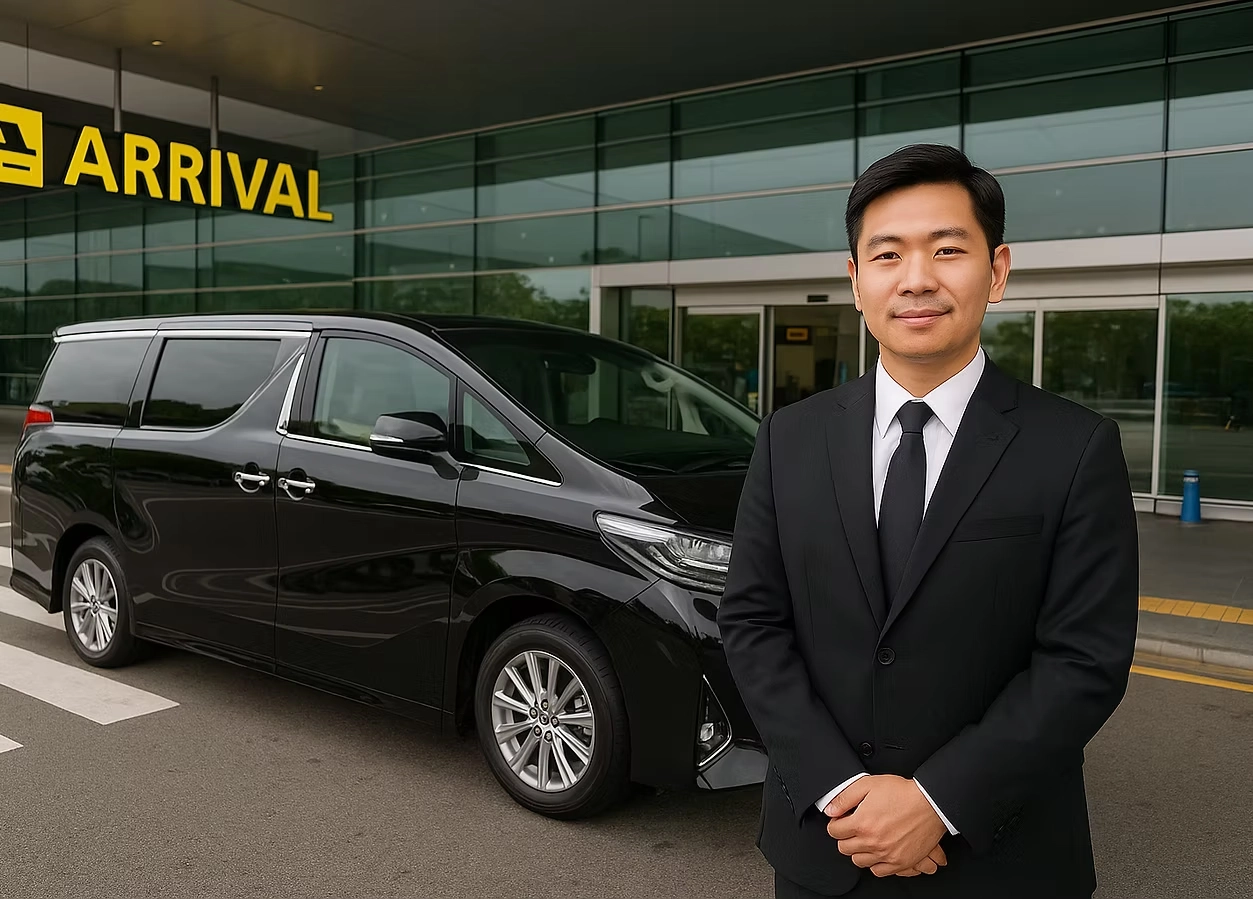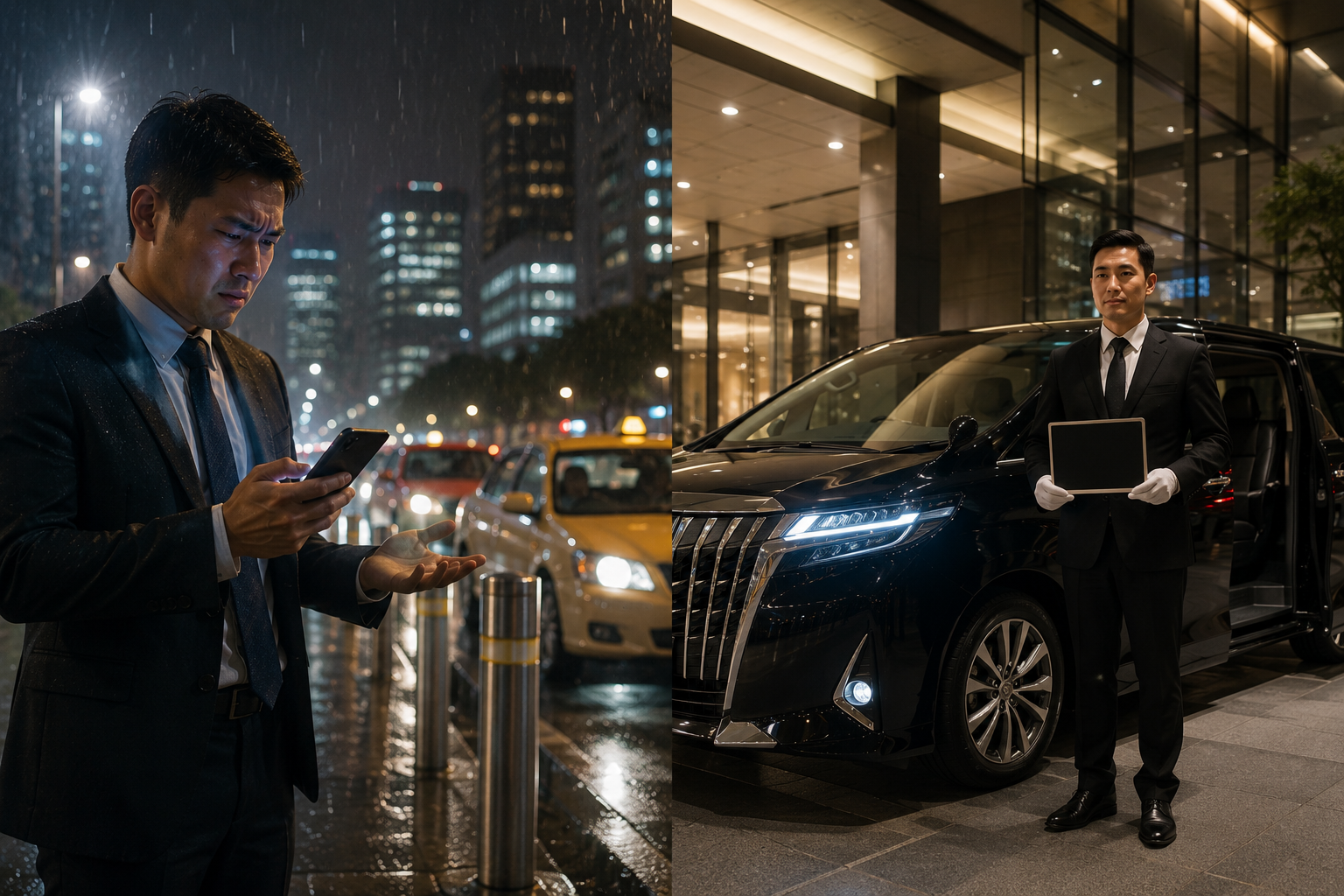
The price difference between a ride-hailing app and a professional corporate chauffeur is measurable. The difference in outcome when something goes wrong is not.
By Jovin Liau · 15 Feb 2026 · 7 min read
Most Singapore companies do not decide to switch from ride-hailing apps to professional corporate chauffeur service because someone read a comparison article. They switch because something went wrong. The following two stories are from companies that became clients of Chauffeur Service Singapore. The details are real. The names are not used.
A Singapore-based company was hosting a potential client from overseas — a senior decision-maker who had flown in specifically to evaluate whether to proceed with a significant contract. This was not a casual visit. The relationship had been built over several months. The meeting was the moment it would either convert or stall.
The executive assistant booked the airport transfer through a ride-hailing app. Standard procedure for the company at the time. The booking was accepted. The flight landed on schedule.
The visiting executive cleared customs at Changi Terminal 3, walked into the arrivals hall, and found no one waiting. No name sign. No driver. After ten minutes of waiting — and unanswered calls to the driver’s number — the booking was cancelled. The driver had accepted the job and then abandoned it without entering the terminal.
The visiting executive spent the next thirty minutes in the taxi queue at Changi, with their luggage, having just completed a long-haul flight, before a deal-defining meeting.
They arrived at the office late. The EA was mortified. The meeting still happened — and the deal was eventually signed — but the EA’s words when they contacted us afterward were direct: “We were lucky. It could have gone the other way. We will never use an app for a client pickup again.”
When they engaged Chauffeur Service Singapore for all subsequent client visits, the protocol was straightforward: flight tracked from departure, chauffeur positioned at the arrivals hall 15 minutes before landing, name sign ready at the exit, luggage handled from the customs door to the vehicle. The visiting client walks out and sees their name. That is the first impression the company now delivers — on every visit.
For a full breakdown of the airport arrival protocol, see our VIP airport transfer guide for Changi.
A Singapore branch office was receiving a visit from several directors based at the company’s regional headquarters. These were not routine visitors. They were the people who set budgets, evaluate whether the local operation is being run to the group’s standard, and report back to the global leadership. The Singapore team was, reasonably, under scrutiny.
The branch had booked transport through a cheaper provider — a company that had quoted below what a professional corporate chauffeur account would have cost. The savings were real. What they did not account for was what happens when the operational gaps in a low-cost provider become visible in front of the people whose opinion of the Singapore branch matters most.
The directors arrived on two separate flights, landing at different Changi terminals within a short window of each other. The driver had not been briefed on the two-terminal split. Coordinating the pickup became visibly chaotic. When the group finally consolidated, there was a significant amount of luggage — appropriate for a multi-day visit. The driver’s impatience was not concealed. Bags were handled roughly. In full view of the guests.
Senior directors notice these things. They are accustomed to a standard. What they witnessed over the next twenty minutes communicated something specific about how the Singapore branch manages its operations. It was not the message the local team intended to send.
A colleague’s referral brought them to us. We took over the remaining transfers the same day. Each driver was fully briefed: guest names, roles, terminal, luggage count, hotel, and onward schedule. Vehicles matched to passenger and luggage volume. Every arrival from that point handled the way visiting directors should be received — quietly, efficiently, and without any visible effort.
By the end of the visit, two of the directors asked the Singapore team directly who had arranged the transport for the second half of the trip. The team passed on our details.
The price difference between the original provider and a professional corporate chauffeur account was marginal — tens of dollars per trip. The difference in what those trips communicated about the Singapore operation was not marginal at all.
Neither company made a bad decision intentionally. They made a cost-optimised decision without fully accounting for what happens when app-based transport fails at a moment that matters.
Ride-hailing platforms are designed for volume and convenience. A driver who cancels an accepted job loses a small rating penalty. For the company whose potential client is now queuing for a taxi, or whose visiting directors are watching luggage being thrown — the cost is something else entirely.
A professional corporate chauffeur account operates on a different model. The driver is assigned specifically to your booking and cannot simply abandon it. The flight is tracked. The briefing is done before the driver leaves the depot. Luggage is handled because that is the standard, not because the driver is having a good day.
At Chauffeur Service Singapore, we take every piece of feedback seriously — positive and negative. Every service failure is reviewed. Every client comment is used to improve the briefing, the driver assignment, and the coordination protocol. We do not treat a completed transfer as a closed file. We treat it as a data point in an ongoing relationship.
Your VIP guests form their opinion of your company before they reach your meeting room. The vehicle they board at Changi is the first touchpoint. Make sure it is not your weakest one.
To set up a corporate account or discuss how we handle client-facing transfers, see our executive chauffeur service or WhatsApp us at +65 8092 7662.
Ready to set up your corporate account?
WhatsApp us — a real person replies in 5–30 minutes.
WhatsApp +65 8092 7662Frequently asked questions
The most common triggers are a service failure at a critical moment — a cancelled driver leaving a VIP guest stranded, surge pricing on an important trip, or a driver who does not meet the professional standard expected for client-facing transport. Once a company has experienced a transport failure that affected a client relationship or a senior executive's experience, the argument for ad-hoc ride-hailing becomes very difficult to sustain.
For standard CBD transfers, professional corporate chauffeur service in Singapore costs more than base ride-hailing fares. However, the comparison changes during peak hours when surge pricing applies, and changes further once GST input tax recovery is factored in — ride-hailing receipts do not qualify as GST tax invoices. For client-facing and executive transport, the cost difference per trip is typically SGD $20 to $50. Against the value of a client relationship or a director's impression of your Singapore operation, this is not a meaningful number.
When a ride-hailing driver cancels, the app reallocates the booking or the passenger must rebook. During peak demand — rain, rush hour, events — reallocation may take 10 to 20 minutes or fail entirely. For a VIP guest at Changi Airport or a CEO with a timed commitment, this is a genuine operational failure with real consequences. A confirmed corporate chauffeur booking assigns a specific driver who cannot cancel and abandon the booking.
If your company books more than three to four executive or client-facing transport trips per week, has had even one service failure with ad-hoc booking, requires invoicing for transport expenses, or has senior executives or visiting clients whose first impression of your company includes the vehicle that collects them — a corporate chauffeur account is the right structure. Setup takes under 24 hours and there is no minimum contract period.
Related reading
Article by
Jovin Liau
Jovin is a passionate strategist focused on building brands that define excellence. As the founder of Veloce Limo, he oversees premium transportation solutions for the shipping, energy, and events industries across Singapore and Malaysia. With a deep background in corporate sales and a commitment to "doing what you love," he specialises in blending operational rigour with a world-class customer experience.