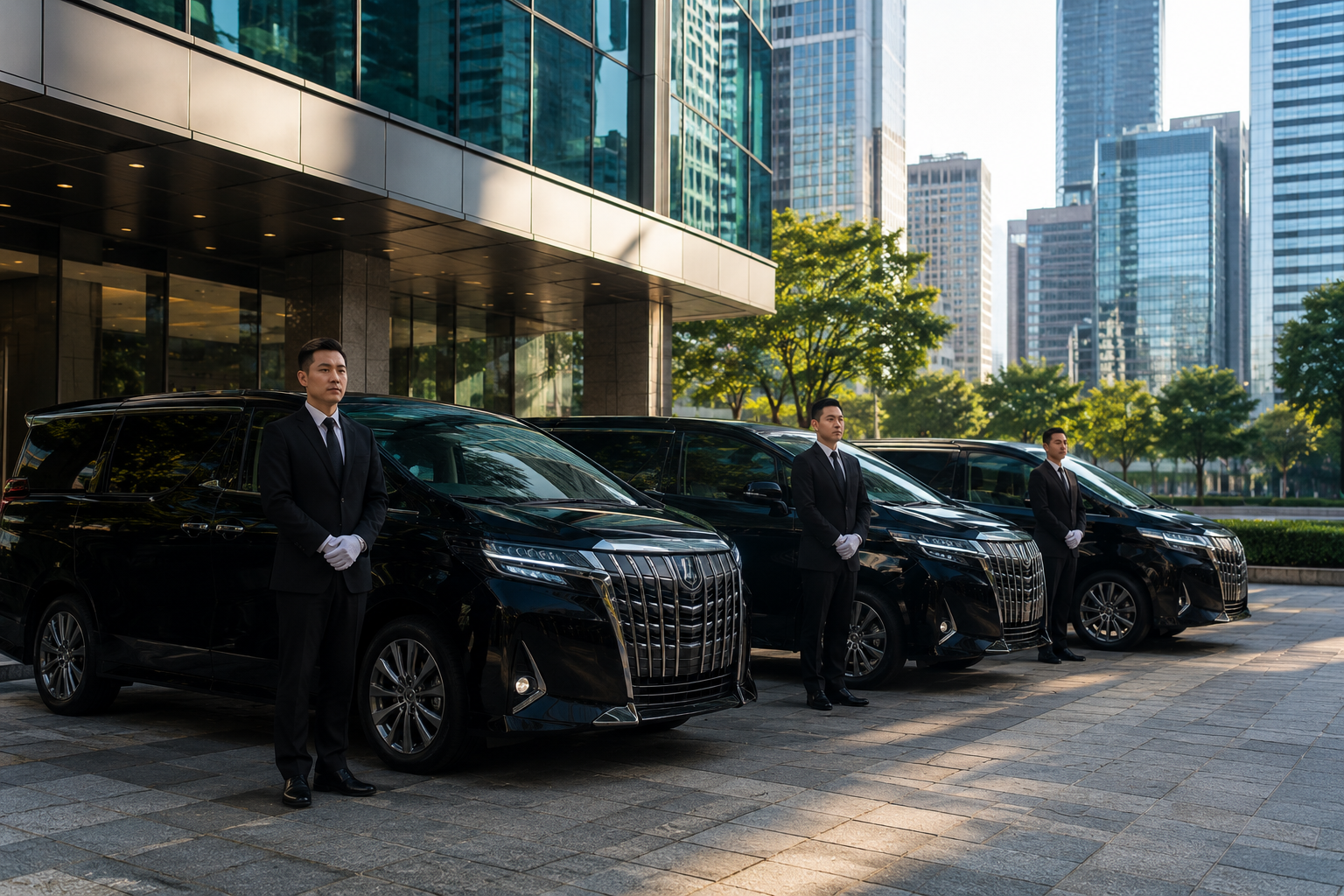
A structured staff transport programme removes the daily friction of employee commuting in Singapore — fixed routes, right-sized vehicles, and one monthly invoice.
By Jovin Liau · 18 Feb 2026 · 8 min read
Staff transport is not a luxury. For Singapore companies with operations in industrial zones, early or late shifts, or office locations poorly served by public transport, it is an operational necessity. The question is whether to manage it well or badly.
Managing it badly means individual staff arranging their own transport for shifts outside MRT hours, ad-hoc van bookings that do not scale, and an HR team fielding complaints about late arrivals. Managing it well means a structured contract with fixed routes, right-sized vehicles, and one monthly invoice.
The most common mistake in staff transport setup is booking vehicles first and designing the route second. The right approach is the reverse: start with where your staff live, cluster by MRT corridor, and design the most efficient collection route before deciding on vehicle class or timing.
For most Singapore employers, 60 to 70% of staff residential addresses cluster within 2 to 3 MRT corridor zones. This informs an efficient multi-pickup route without the cost and complexity of door-to-door residential routing. The standard model: staff self-commute to the nearest major MRT interchange, and the company vehicle collects at a confirmed time.
Common collection interchanges for industrial zone routes: Jurong East and Boon Lay for Jurong Island and Tuas. Woodlands and Admiralty for Senoko and Woodlands industrial estates. Tampines and Changi for Changi South and airport-adjacent operations.
Right-sizing is where most staff transport contracts save money. A 13-seater van running 8 passengers daily is costing you 5 empty seats every trip. Over a 20-working-day month, that is 100 empty seat-trips on your invoice.
The correct approach: confirm headcount per route per shift, add a 10% buffer for variation, and choose the smallest vehicle that covers the confirmed requirement with that buffer. Review sizing at contract renewal or when headcount changes exceed 15%.
Manufacturing, logistics, and airport operations run around the clock. Early morning shifts starting at 06:00 and night shifts ending after 23:00 cannot rely on public transport for punctuality. A staff transport programme that only covers the main shift leaves your late-shift workers unserved.
For three-shift operations, three distinct route schedules — each with its own confirmed pickup times and vehicle assignments — cover the full cycle. Shift overlap periods, where an incoming and outgoing shift share the same vehicle window, are managed with staggered departure times or additional capacity.
For a broader look at how staff transport fits within your company’s ground transport programme, see our staff and worker transport service page. To get a route quote based on your shift schedule and staff locations, WhatsApp +65 8092 7662 with your operational brief.
Ready to set up your corporate account?
WhatsApp us — a real person replies in 5–30 minutes.
WhatsApp +65 8092 7662Frequently asked questions
Contact a corporate transport provider with your company location (old and new if relocating), staff residential clustering by postal district or MRT line, shift start and end times, and headcount per shift. The operator maps the most efficient route structure — typically MRT interchange collection rather than door-to-door — and provides a monthly fixed-rate quote based on vehicle class and deployment frequency.
Staff transport in Singapore covers all residential areas and all industrial and commercial zones including Jurong Island, Tuas, Senoko, Changi South, and Woodlands. Collection points are typically at major MRT interchanges — Jurong East, Boon Lay, Woodlands, Tampines, Changi — with the vehicle covering the last mile to industrial or office sites that are poorly served by public transport.
Staff transport vehicles in Singapore range from Toyota Hi-Roof Hi-Ace vans (up to 13 seats) through Toyota Coaster (up to 24 seats) to full coaches (up to 49 seats). Vehicle class is matched to confirmed headcount with a 10% buffer. A 13-seater on a consistent 7-passenger route is unnecessary cost that compounds monthly — right-sizing is part of the route design process.
Staff transport contracts in Singapore are structured as fixed monthly rates covering all trips within the confirmed schedule. Monthly invoices are itemized by route, date, and vehicle. Public holiday surcharges are disclosed upfront in the contract rather than applied as surprise line items. Monthly trip completion reports are provided for HR compliance and cost center allocation.
Related reading
Article by
Jovin Liau
Jovin is a passionate strategist focused on building brands that define excellence. As the founder of Veloce Limo, he oversees premium transportation solutions for the shipping, energy, and events industries across Singapore and Malaysia. With a deep background in corporate sales and a commitment to "doing what you love," he specialises in blending operational rigour with a world-class customer experience.